
Rev. Mark H. Creech


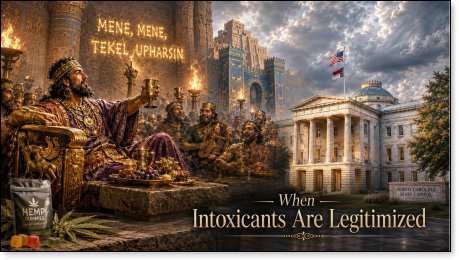
A haunting scene appears in the fifth chapter of the book of Daniel.
Belshazzar, king of Babylon, gathered a thousand of his lords for a great feast. Wine flowed freely. The king and his guests drank from the sacred vessels taken from the Temple in Jerusalem and celebrated their idols.
While they were intoxicated and carousing, destruction stood at the door.
Before the party ended, the handwriting appeared on the wall. Babylon had been weighed in the balances and found wanting. That very night, Belshazzar was slain, and the kingdom passed into the hands of the Medes and Persians.
It would be wrong to say Babylon fell simply because its rulers were engaged in drunkenness and debauchery. Daniel presents a more profound problem: they were arrogant, irreverent, and morally blind, which led to God’s judgment.
Still, the picture is unforgettable. The wine may not have been the main cause of Babylon’s fall, but the intoxication and revelry were part of a broader culture of excess and self-indulgence that left its people feasting while their kingdom was collapsing around them.
A society is in serious danger when the mere existence of an appetite becomes an argument for legitimizing and commercializing it. The question is not simply whether people desire something, but what that desire costs the broader culture when the government gives it legal sanction.
As lawmakers consider intoxicating hemp products, North Carolina should remember that lesson.
For several years, products containing intoxicating forms of THC have spread through vape shops, convenience stores, gas stations, and other retailers across the state.
This was never a deliberate decision by the North Carolina General Assembly to establish a recreational marijuana market.
The market developed largely through a loophole created after the federal government legalized hemp for farmers and agricultural purposes. But manufacturers found ways to exploit that loophole by manipulating, concentrating, and chemically converting hemp-derived cannabinoids into products capable of producing potent intoxicating effects.
Thus, without the state ever voting to legalize recreational marijuana, something very much like it appeared on store shelves.
Now we are being told that the answer is regulation.
Certainly, the current situation is unacceptable. Intoxicating products should not be easily accessible to children and teenagers, should not be deceptively packaged to entice them, and should not be sold to adults without adequate safeguards.
But the debate is increasingly framed as if North Carolina has only two choices: an unregulated intoxicating cannabis market or a regulated one.
This is a false choice!
There is a third option: close the loophole.
That is essentially what the North Carolina Senate voted to do earlier this year – to close the loophole.
The conference report for House Bill 328- Regulate Hemp-Derived Consumables would prohibit finished hemp-derived consumable products containing more than 0.4 milligrams of total THC per container, as well as products containing synthetic or chemically converted cannabinoids. It would also prohibit possession of hemp-derived consumables by anyone under 21.
The Senate adopted the conference report by an overwhelming bipartisan vote of 37-6.
The vote demonstrated that lawmakers need not surrender to the argument that intoxicating hemp is now so entrenched that the only practical response is to license, regulate, and tax it.
The House should follow the Senate’s lead.
Meanwhile, Governor Josh Stein’s North Carolina Advisory Council on Cannabis is examining broader cannabis policy. The governor has spoken of creating a “safe, legal market for adults,” and the Council has considered models extending well beyond simply keeping intoxicating hemp away from minors.
A profound difference exists between controlling an unintended market and legitimizing it.
Once North Carolina licenses an intoxicating cannabis industry, regulates it, taxes it, and builds a permanent framework around it, the state will have transformed an accidental loophole into a state-sanctioned commercial enterprise.
We have seen this pattern so many times. Will we ever learn?
Government expands alcohol and becomes dependent on alcohol revenues. Government expands gambling and becomes dependent on gambling revenues. Now another intoxicating industry is being presented as acceptable if government regulates it carefully enough.
There is something morally troubling about the government capitalizing on its own citizens' weaknesses. The state should not build revenue streams around addictions, compulsions, or appetites that harm them. Nor is it sound fiscal policy. Once the government becomes dependent on revenue generated by vice, it acquires a financial interest in the continuation, and often the expansion, of the very behavior that helps erode the character of its people and culture. When that happens, danger stands at the door.
Once an activity generates substantial tax revenue, businesses invest, lobbyists organize, and government budgets come to rely on that income. What was once controversial becomes normalized, and what was initially promised as limited seldom remains so.
Another argument is that these products already exist.
However, existence doesn’t confer legitimacy.
Illegal drugs exist. Illegal gambling exists. Underage drinking exists. Their presence does not require the government to create a legal commercial market for them.
The proper question is not merely “How do we make intoxicating hemp safer to sell?”
The right question is, “Should North Carolina be selling it at all?”
There is also an economic argument. Hemp advocates cite billions of dollars in economic activity and thousands of jobs created.
Lawmakers should be careful not to confuse the legitimate hemp industry with the intoxicating THC industry. Hemp has many lawful and useful applications, including fiber, textiles, seed, oil, food ingredients, industrial products, and nonintoxicating preparations.
The Senate's approach does not declare war on legitimate hemp farming.
It draws a line at products intended to intoxicate.
North Carolina never consciously chose to create a recreational THC marketplace. We should not now be told that, because such a marketplace emerged through a loophole, the state has no choice but to regulate and sustain it.
We do have a choice.
Protect legitimate hemp. Protect children. Prohibit synthetic and chemically converted cannabinoids. Establish a meaningful THC threshold. Give law enforcement clear standards. And refuse to turn a loophole into another state-sanctioned vice industry.
The haunting thing about Babylon’s feast was not simply that people were drinking. It was that a nation at the height of its confidence had become absorbed in excess, self-indulgence, and false security even as forces of destruction were already gathering against it. That ancient scene ought to trouble us. When a society begins turning its weaknesses into industries, its appetites into revenue streams, and its vices into matters of public policy to be managed rather than restrained, it does more than invite danger. It lowers its guard and helps pave the way for its own destruction.
Sooner or later, the handwriting is on the wall.
Wisdom does not consist of learning how to regulate an intoxicant.
Wisdom means closing the door.
________________________________
Read this article and many others by Dr. Creech at RevMarkCreech.org.
Share Truth for Our Times
If this article helped you in some way, please consider forwarding it to a friend, pastor, or family member.
Speaking Engagements
Churches, ministries, and civic organizations are invited to prayerfully consider Dr. Mark Creech as a speaker for worship services, revival meetings, conferences, and special events. Dr. Creech speaks on biblical faith, cultural engagement, public policy, and the Christian worldview, delivering messages that are faithful to Scripture and deeply relevant to the challenges of our time.
For scheduling inquiries:
RevMarkCreech.org/booking
919-915-3033
mark@revmarkcreech.org
© Rev. Mark H. CreechThe views expressed by RenewAmerica columnists are their own and do not necessarily reflect the position of RenewAmerica or its affiliates.