
Rev. Mark H. Creech


On September 11, 2001, as President George W. Bush flew over Washington aboard Marine One and looked down at the burning Pentagon, he reportedly said, "The mightiest building in the world is on fire. That's the face of war in the 21st century."
The president recognized that warfare had changed. The enemy, the battlefield, and the weapons of war were taking on a different face.
Something similar is unfolding in America's ongoing culture war.
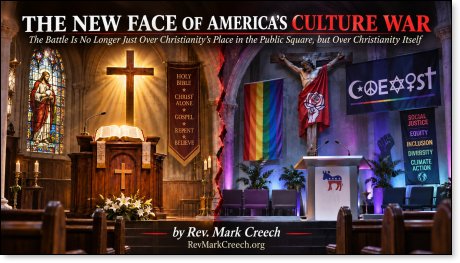
The contest is no longer simply about whether Christian values should influence public life. Increasingly, the battle is about what Christianity itself means.
The November 3 midterm elections brought this development into sharper focus.
Baptist News Global reported that six progressive Christian clergy or lay leaders won their elections. In Kansas, the Rev. Adam Hamilton, founding pastor of Church of the Resurrection, defeated incumbent Republican Senator Roger Marshall. In Texas, James Talarico, a Presbyterian seminarian known for frequently invoking Jesus' teachings, defeated Republican Ken Paxton for a seat in the United States Senate.
Other successful candidates included the Rev. Frederick Haynes III of Dallas, the Rev. Sarah Trone Garriott of Iowa, and Presbyterian minister Lindsay James. In North Carolina, LaKesha Womack, an ordained African Methodist Episcopal Zion minister, also emerged victorious in unofficial returns over incumbent Republican Congressman Tim Moore.
This development did not begin with the 2026 elections. In January 2021, Georgia voters elected the Rev. Raphael Warnock, senior pastor of Atlanta's historic Ebenezer Baptist Church, to the United States Senate. Warnock was reelected in 2022. His election, followed by the success of other religiously identified Democratic candidates in 2026, illustrates the growing visibility and electoral influence of progressive Christianity in American public life.
Their message emphasizes compassion, inclusion, economic justice, care for immigrants, and concern for marginalized people. Christians should take these issues seriously. But the question is not whether Christians should care about these matters. They should. The question is whether the theological framework through which these concerns are interpreted remains consistent with historic biblical Christianity.
In some prominent expressions of progressive theology, the departures from historic Christian doctrine are substantial, extending far beyond disagreements over public policy.
Several theological differences merit particular attention.
When Culture Becomes the Judge of Scripture
The first and most consequential issue concerns the authority of the Bible, God's Word.
Historic evangelical Christianity maintains that Scripture is divinely inspired, without error, and authoritative in all matters of faith and practice, and that human philosophy, political ideology, and changing cultural standards must be measured against its teachings.
"All Scripture is given by inspiration of God" (II Timothy 3:16) declared the apostle Paul.
Certain progressive theological approaches, however, regard portions of Scripture as reflecting the cultural limitations of their ancient authors, allowing contemporary moral perspectives to determine which biblical teachings remain binding. The Bible becomes something like a buffet, with some offerings eagerly embraced and others rejected as distasteful or outdated. This approach matters especially in discussions of sexuality, gender, marriage, and other contested moral questions.
Granted, faithful biblical interpretation must consider a passage's literary context, historical circumstances, and its relationship to the whole counsel of Scripture. But one of the greatest dangers in biblical interpretation is allowing our presuppositions to govern what Scripture means, rather than letting Scripture examine and correct them.
The central question of our time is: Does Scripture judge our culture, or does our culture judge Scripture? More pointedly: Do we approach Scripture to discover what God says, or to find support for what we have already decided to believe? If contemporary political and social convictions become the final authority, God's revelation of Himself and His will is effectively subordinated to human judgment.
When Jesus Becomes Primarily a Social Reformer
A second concern involves Jesus Christ's identity and mission.
Historic Christianity proclaims that Jesus is not merely a moral teacher, nor was He primarily a social revolutionary. Although He showed compassion for the oppressed, the marginalized, and the poor, these acts were not His central mission. Jesus is the eternal Son of God, fully divine and fully human, who came to reconcile sinful humanity to God and to deliver believers from the judgment their sins deserve. He accomplished this through His substitutionary death on the cross and His bodily resurrection (John 1:1–14; Romans 5:8–10; I Peter 3:18).
In progressive Christian expressions, Jesus is portrayed primarily as a challenger of oppressive systems and conventional social arrangements. The emphasis falls heavily on radical love, inclusion, and social transformation. Yet the Gospel is far more than a summons to improve earthly conditions.
Paul summarized Christianity's essential message as Christ dying for our sins, being buried, and rising again, according to the Scriptures (I Corinthians 15:3–4). This is the very heart of the Christian faith. When a believer is baptized, he publicly identifies with Christ in His death, burial, and resurrection, outwardly testifying to the saving truth he has embraced in his heart.
Christianity, when genuinely embraced and practiced, produces positive social consequences. Yet its central proclamation is not that humanity can build a better society through political reform. Rather, sinful people, alienated from their Creator, must be reconciled to God through repentance and faith in Jesus Christ. Through the Holy Spirit's regenerative work, they are born again, given new life, and progressively transformed into the likeness of their Savior, with the promise of eternal life (John 3:3–7; II Corinthians 5:17; Romans 8:29).
When salvation is treated primarily as a matter of social improvement, the Gospel's eternal dimensions are obscured. Worse still, when good works are presented as the means of obtaining God's favor and eternal acceptance, the very foundation of Christianity is repudiated. Salvation becomes humanity's achievement rather than God's gracious gift. Scripture could hardly be clearer: "For by grace are ye saved through faith; and that not of yourselves: it is the gift of God: Not of works, lest any man should boast" (Ephesians 2:8–9).
When Christ's Exclusivity Is Questioned
A third theological concern involves the uniqueness of Jesus Christ.
Historic Christianity has consistently taught that Christ is the only Savior and mediator between God and humanity. Jesus declared, "I am the way, the truth, and the life: no man cometh unto the Father, but by me" (John 14:6).
Talarico offers a particularly striking example of the theological questions surrounding religious pluralism. He has compared Judaism, Christianity, and Islam to successive seasons of a television program. In a sermon condemning Christian nationalism, he spoke of numerous pathways to the sacred and emphasized that God transcends the boundaries of particular religious identities.
Christians should certainly acknowledge admirable qualities among people of other faiths, and defend religious liberty. But tolerating those who practice their religion peacefully is not the same as declaring competing religious claims equally valid.
When the apostles proclaimed Christ, they boldly declared, “Neither is there salvation in any other: for there is none other name under heaven given among men, whereby we must be saved” (Acts 4:12). The Christian faith cannot surrender that conviction without surrendering something essential to its historic identity.
Progressive theological expressions challenge this exclusivity, seemingly applying the contemporary language of Diversity, Equity, and Inclusion to the question of salvation. Yet while all people possess equal dignity and deserve equal treatment under the law, Scripture does not teach that all religious beliefs are equally true or that every spiritual path leads to God. The Gospel extends its invitation to everyone, but it offers salvation through Jesus Christ alone (I Timothy 2:5; John 3:16–18).
From Genesis onward, Scripture reveals that God has always provided the appointed means of deliverance from His judgment on sin. In Noah's day, salvation from the Flood was found only inside the Ark; at Passover, deliverance came through the blood of the lamb; and in the wilderness, healing came only by looking upon the bronze serpent God commanded Moses to lift up. These divinely appointed means of deliverance foreshadowed the ultimate and exclusive provision for humanity's redemption through Jesus Christ. God's mercy has always been abundant, but the means of redemption have never been left to human invention.
When Biblical Morality Is Reinterpreted
A fourth concern involves sexual ethics and the nature of God. Progressive Christian leaders frequently interpret biblical teaching differently from conservative evangelicals regarding abortion, marriage, homosexuality, and gender identity.
Progressive Christian leaders have often argued that the Bible does not explicitly mention abortion or same-sex marriage, even as they appeal to Scripture to defend LGBTQ+ inclusion. Yet the absence of modern terminology, or the prevailing conclusions of contemporary scientific, professional, and academic disciplines, does not mean Scripture has nothing authoritative to say about a contemporary moral question.
Traditional Christian teaching derives its understanding of marriage and sexual morality from the creation account, the teachings of Jesus, and the apostolic writings. Jesus Himself referred to God's creation of humanity as male and female when discussing gender and marriage (Matthew 19:4–6; Genesis 2:24; I Corinthians 6:18–20).
Christians who maintain these historic convictions also bear an obligation to treat every person with dignity, compassion, and love. Faithfulness to biblical teaching should never excuse cruelty. However, love and moral affirmation are not necessarily identical.
An especially revealing example of the present theological controversy arose when Talarico publicly declared, "God is nonbinary." He later explained that he meant God transcends human gender categories. Indeed, historic Christian theology has never taught that God the Father possesses a biological sex. God is spirit, and Scripture occasionally employs feminine imagery to convey aspects of His care (John 4:24; Isaiah 66:13). Nevertheless, classical Christianity regards God's self-revelation as authoritative, including the personal language of Father and Son (Matthew 6:9; John 5:19–23).
There is a difference between affirming that God transcends human biological limitations and interpreting His nature through contemporary categories of gender identity. The question is not simply which terminology sounds more inclusive or culturally acceptable. It is whether our language concerning God faithfully reflects what He has revealed about Himself.
The Battle Before the Church
The growing influence of progressive Christian leaders in politics presents a serious challenge to the church. Competing understandings of Scripture, Christ, salvation, and morality are increasingly being advanced under the same banner of Christianity.
The apostle Paul warned against "another gospel" (Galatians 1:6–9) and "another Jesus" (II Corinthians 11:4). His warnings remind us that invoking Christ, quoting Scripture, or professing the Christian faith does not necessarily establish fidelity to biblical truth. Christians must exercise discernment, testing every theological claim against God's Word, even when it comes from those whose political views they may favor.
Never has there been a time in our nation's history when the essential doctrines of the Christian faith needed to be more boldly proclaimed, both within the church and in the public square. Progressive theology, when it substitutes human philosophy for divine revelation, resembles a modern Tower of Babel, promising unity and a better world while ultimately producing estrangement from God, spiritual confusion, cultural chaos, and deepening division.
On September 11, President Bush looked upon a burning Pentagon and recognized a new face of warfare. Today, Christians looking across America's political landscape must recognize a new dimension of the culture war.
The battle is no longer merely over whether Christianity will have a place in America's public life. It is also over which understanding of Christianity will shape that life.
______________________________
Read this article and many others by Dr. Creech at RevMarkCreech.org.
Share Truth for Our Times
If this article helped you in some way, please consider forwarding it to a friend, pastor, or family member.
Speaking Engagements
Churches, ministries, and civic organizations are invited to prayerfully consider Dr. Mark Creech as a speaker for worship services, revival meetings, conferences, and special events. Dr. Creech speaks on biblical faith, cultural engagement, public policy, and the Christian worldview, delivering messages that are faithful to Scripture and deeply relevant to the challenges of our time.
For scheduling inquiries:
RevMarkCreech.org/booking
919-915-3033
mark@revmarkcreech.org
______________________________________________________________________________________________
NOTE TO RENEW AMERICA READERS:If you can help Stephen Stone, President and Editor of RenewAmerica.com with his medical expenses (for more information, click here), please consider sending a gift of any size to:
- GoFundMe.
- Steve’s PayPal account using his email address (editor@renewamerica.com)—that would especially help.
- DeeAnn Stone's Venmo account
- Or if you’d rather send a check, you could send it to:
Stephen Stone
PO Box 50502
Provo, UT 84605-0502
Please let us know if you send a check, by emailing Stephen using the above email address, so that we'll know when to check our PO box in town.
Thank you, and God bless,
RenewAmerica staff
© Rev. Mark H. Creech
The views expressed by RenewAmerica columnists are their own and do not necessarily reflect the position of RenewAmerica or its affiliates.