
Rev. Mark H. Creech


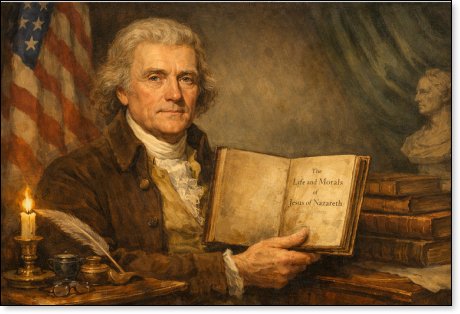
There was once an effort, quiet, deliberate, and telling, to reshape the story of Jesus Christ into something more palatable to human reason. Thomas Jefferson, a man of brilliance and influence, a man who became the third president of the United States, took a razor to the pages of the New Testament and constructed his own version of the Gospels. Gone were the miracles. Gone were the angels. Gone was the supernatural. What remained of the person of Jesus was a great moral teacher, respected, but considerably reduced.
Jefferson’s account ends with these somber words: “There laid they Jesus, and rolled a great stone to the mouth of the sepulchre.” There, in his telling, the story ends.
More than a century later, the United States Congress printed and distributed this work among its members – not as Scripture, but as a reflection of Jefferson’s religious philosophy. Still, the symbolism is striking: a version of Christianity with the resurrection carefully removed.
But here is the problem – one that no penknife, however precise, has ever been able to solve: the resurrection of Jesus Christ will not stay buried.
You can cut it out of a page, but you cannot cut it out of history.
For nearly two thousand years, the claim that Christ rose from the dead has stood not as a myth whispered in the shadows, but as a proclamation declared in the open, anchored in eyewitness testimony, affirmed by an empty tomb, and sealed by the transformed lives of those who once doubted and feared.
If Jesus did not rise, then Jefferson was right to end the story at the grave.
But if Jesus did rise, then Jefferson’s version is not merely incomplete. It is profoundly mistaken.
The evidence demands that we take that question seriously.
If the resurrection of Jesus Christ could be dismissed, it would have been dismissed long ago. It was first examined not by sympathetic believers but by hostile witnesses, skeptical authorities, and fearful followers. Still, the more carefully the evidence is examined, the clearer it becomes: something happened that no natural explanation can sufficiently explain.
Start with the tomb itself.
The body of Jesus Christ was placed in a known grave, sealed with a great stone, and secured under guard. The tomb was not left unattended or vulnerable to tampering. It was officially sealed – a mark of authority meant to prevent interference – and watched by trained soldiers. Yet on the third day, the tomb was empty.
This is not merely a claim made by Christians. It is a fact that even early opponents were forced to explain. They did not argue that the body remained. Instead, they said the disciples stole it. That explanation, however, collapses under its own weight. At the very time the theft was supposed to have occurred, the disciples were scattered, frightened, and in hiding – hardly the profile of men executing a coordinated deception under the watch of guards and sealed authority. In that sense, they had an alibi. Moreover, men in fear for their lives do not suddenly muster the courage to outmaneuver trained soldiers, break an official seal, and carry out a fraud they would spend the rest of their lives suffering and dying to defend.
That leads directly to the witnesses.
The resurrection was not proclaimed on the basis of a single vision or private experience. It was declared by many men and women, individuals and groups, over time and in various places. These were not mystical impressions, but genuine encounters. They spoke with Him. They touched Him. They ate with Him. The Apostle Paul would later write that more than five hundred people saw the risen Christ at one time, many of whom were still alive, which was an open invitation to verify the claim.
Hallucinations do not happen to groups. Nor do they eat broiled fish.
Then consider the transformation.
Before the resurrection, the disciples were broken men. After the crucifixion, they hid behind locked doors, fearing for their lives. Yet within days, these same men stood in the streets of Jerusalem proclaiming that Jesus was alive, and they did so at great personal cost. Nearly all of them would suffer persecution and die as martyrs.
People will die for what they believe to be true. But no one dies for what they know to be a lie.
Something changed them. And nothing less than the resurrection sufficiently explains it.
Even more striking is the conversion of skeptics.
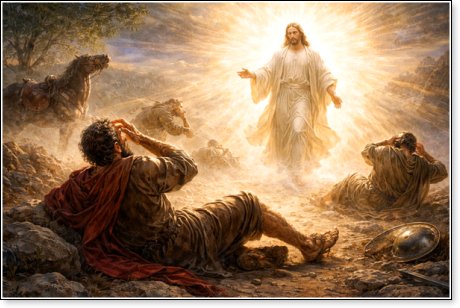
James, the brother of Jesus, did not believe in Him during His earthly ministry. Yet after the resurrection, he became a pillar of the early church and ultimately gave his life for the faith. Then there is Paul, a fierce opponent of Christianity, a man determined to wipe it out. Yet after what he testified was an encounter with the risen Christ, he became its most tireless advocate.
Men do not abandon power, reputation, and security for a message they know to be false -especially one that brings suffering in its wake.
Then there is the rise of the church itself.
Christianity did not slowly evolve in a distant land. It exploded into existence in the very city where Jesus had been crucified. Its central message was not a philosophy or even morality, but a fact: “He is risen.” This proclamation was made in the face of intense opposition from both religious and political authorities. Still, it spread rapidly, relentlessly, and irreversibly.
A lie does not ignite a movement that endures severe bouts of oppression and transforms the world.
Finally, there is the matter of the record itself.
The Gospel accounts bear the marks of authenticity. They include details that no fabricator would possibly invent – women as the first witnesses in a culture that discounted their testimony, the cowardice of the disciples, the doubts of those closest to Jesus. These are not the embellishments of legend, but the fingerprints of raw truth.
Taken individually, each of these lines of evidence is significant. Taken together, they are overwhelming.
The empty tomb.The eyewitness accounts.
The transformation of the disciples.
The conversion of skeptics.
The birth and endurance of the church.
They converge on a single, unavoidable conclusion: Jesus Christ did not remain in the grave behind that stone.
Why the Resurrection Must Be Believed
Nevertheless, the resurrection of Jesus Christ is not merely a matter to be examined – it is a truth that must be believed.
The Scriptures do not present the resurrection as an optional doctrine. It stands at the very heart of the Gospel itself. The Apostle Paul declared:
“That if thou shalt confess with thy mouth the Lord Jesus, and shalt believe in thine heart that God hath raised him from the dead, thou shalt be saved.” (Romans 10:9)
To deny the resurrection is not simply to reject a miracle. It is to reject salvation.
Again, the Scripture is unmistakably clear:
“And if Christ be not raised, your faith is vain; ye are yet in your sins.” (I Corinthians 15:17)
If Christ did not rise, then sin remains unconquered. Death still reigns. The grave still holds its captives. Faith collapses, hope evaporates, and redemption is undone.
However, if Jesus did rise from the dead, and the evidence compels us to conclude that He did, then absolutely everything changes.
The resurrection is God’s declaration that the sacrifice of Christ – his blood shed on the Cross to atone for our sins, was accepted. It is Heaven’s affirmation that the debt for sin has been paid in full, that death has been defeated, and that eternal life is now offered freely to all who will simply believe.
This is why the earliest preaching of the church centered on this one, explosive truth:
God hath raised Him from the dead.
Therefore, the question of faith becomes deeply personal. Will we turn from sin and trust in Christ and what He has done to redeem us? Everyone confronted with the claims of the gospel must make a decision.
It is not enough to admire Christ.It is not enough to study the evidence.
It is not enough to acknowledge Him as a great moral teacher.
One must come to Him in repentance and faith – trusting not merely in His life or His teachings, but in His death for sin and His victorious bodily resurrection from the grave.
For the same power that raised Jesus Christ from the dead is the power that brings spiritual life to those who believe – and guarantees their resurrection yet to come.
What Difference Does It Make?
An army chaplain once told of accompanying a regiment of soldiers on an overnight training mission. They camped in an open field, bedding down in neat rows. During the night, a light snow fell, followed by freezing rain. By morning, each soldier, bundled in his sleeping bag, had become a white, icy mound on the ground.
The chaplain rose early and looked out across the field. Row after row, the frozen forms stretched before him. He later said it looked eerily like a vast cemetery, countless graves lying silent under the weight of winter.
Then it happened.
The bugler sounded reveille.
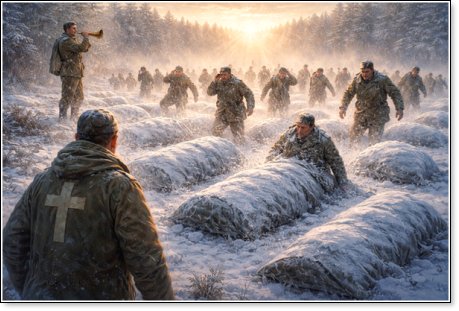
All at once, those frozen mounds began to stir. One by one, men rose up – breaking through the crust of snow and ice – standing to their feet, alive and moving.
“What a thrilling sight,” the chaplain said. “It was like witnessing the resurrection.”
That is precisely the point.
If Jesus Christ is still in the grave, then the world remains a field of frozen tombs that are cold, silent, and without hope. Death has had the final word. The stone remains unmoved.
But if Christ has risen – and the evidence declares that He has – then the grave is not the end. It is only the place from which God calls His people to rise.
The same voice that summoned those soldiers from their icy sleep is but a faint echo of a far greater call – the voice of the Son of God, who said, “I am the resurrection, and the life” (John 11:25).
Jefferson stopped at the stone.
The stone did not hold.
One day, at the sound of a greater trumpet, all who are His will rise, breaking through the final frost of death itself because Jesus Christ did not remain in the grave.
© Rev. Mark H. CreechThe views expressed by RenewAmerica columnists are their own and do not necessarily reflect the position of RenewAmerica or its affiliates.